

Builds community ownership through sustained engagement with local stakeholders
20 drip-irrigation pilots planned for 2026–27 to advance efficient agricultural water use
Tetra Pak, in partnership with Alternative Development Initiatives (ADI), today handed over rejuvenated community ponds in Pur and Rase villages of Khed Taluka, Pune, marking a key milestone under its Integrated Water Resource Development and Management (IWRDM) Programme. The handover, held in the presence of Gajanan Patil, CEO, Zilla Parishad Pune, places the assets in the stewardship of the local communities, following a phased programme of water conservation and community-led interventions undertaken since 2024.
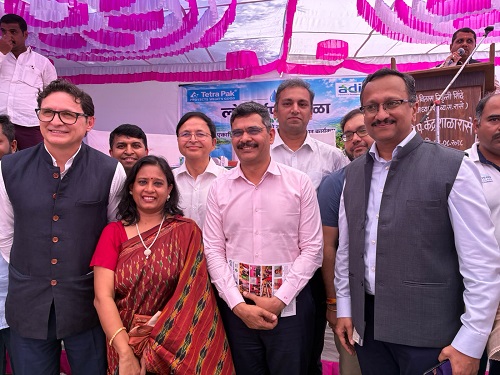
Gajanan Patil, CEO, Zilla Parishad Pune, joined Tetra Pak leaders at the IWRDM Programme community handover in Khed, Pune
Tetra Pak’s first social impact programme in India focused on water conservation, the initiative has enhanced the combined water-holding capacity of the rejuvenated structures to 58.89 million litres and created an estimated annual groundwater recharge potential of 73.61 million litres across Pur and Rase. The programme was developed following a landscape-level assessment of 188 villages across Khed Taluka, of which six villages were shortlisted for detailed assessment and Pur and Rase were selected for implementation.
Commenting on the occasion, Gajanan Patil, CEO, Zilla Parishad Pune said, “Addressing resource challenges requires collective effort from communities, government and the private sector. Pur and Rase have faced challenges around water availability, and initiatives such as this can make a meaningful difference at the local level. We appreciate the efforts of Tetra Pak and ADI in working with the communities to strengthen water security and create long-term impact.”
73.61 million litres annual groundwater recharge potential created
58.89 million litres water-holding capacity established
61 women mobilised through six self-help groups
23 community awareness and capacity-building programmes conducted
Over 830 cumulative participations recorded
20 drip-irrigation pilots planned for 2026-27
A phased approach to strengthening water security
Implemented in phases since 2024, the programme began in Pur, later expanding to Rase, combining water-asset rejuvenation with groundwater, and rainfall monitoring and community-led water management. The interventions have increased water-holding capacity from 11.16 to 32.13 million litres in Pur and from 11.27 to 26.76 million litres in Rase, creating an estimated annual groundwater recharge potential of 40.16 million litres and 33.45 million litres, respectively.
Cassio Simoes, Managing Director, Tetra Pak South Asia, said, “Chakan has been central to Tetra Pak’s journey in India, and with that comes a deep sense of responsibility towards the communities around us. For us, sustainability is about creating lasting value- not only through the way we operate, but also by helping strengthen the resilience of the communities and ecosystems we are part of. In Pur and Rase, we have taken a science-led, community-centred approach to water security, addressing both the availability and responsible management of this critical resource. As we hand over these assets to the community, we are reinforcing what has been fundamental to the programme from the outset: building local ownership so that the impact can endure well beyond the intervention itself.”
Building community ownership beyond infrastructure
Community participation has been integral to the programme, with interventions extending beyond water infrastructure to livelihood development and environmental awareness. To date, the initiative has mobilised six self-help groups involving 61 women, with training and guidance across livelihood skills including stitching, soap making, etc. School awareness sessions have also engaged students on water conservation, plantation, environmental awareness and responsible use of local resources.
Overall, the programme has conducted 23 training, awareness and community activities, recording over 830 cumulative participations, helping build local capacity and ownership to support the long-term sustainability of the interventions.
Sarang Kulkarni, Hydrogeologist, Alternative Development Initiatives (ADI), said, “The IWRDM Programme has been shaped by understanding the local groundwater conditions, existing water resources and the needs of the communities in Pur and Rase. Along with rejuvenation of the village water-harvesting structures, interventions such as open-well recharge and rooftop rainwater harvesting are helping strengthen local recharge and improve the use of available rainwater. The rejuvenated structures have increased the combined water-holding capacity by more than 36 million litres, with an estimated annual groundwater recharge potential of 73.61 million litres. Regular groundwater and rainfall monitoring is helping us better understand seasonal water availability, while our work with farmers, women’s SHGs, youth and schoolchildren is building awareness, skills and local ownership. The next phase will further strengthen this through seasonal water budgeting, farmer capacity building and drip-irrigation pilots, helping communities use water more efficiently and sustain these benefits over the long term.”
The next phase: efficient agriculture and sustained stewardship
The programme will now focus on consolidating the gains made across Pur and Rase through continued groundwater monitoring, community stewardship, livelihood and school-based interventions. It will also strengthen efficient agricultural water use, with 20 drip-irrigation pilots planned for 2026–27, supported by seasonal water budgeting and farmer capacity building.
The IWRDM Programme adds to Tetra Pak’s growing portfolio of sustainability initiatives in India, spanning climate, circularity and community impact. Through these efforts, the company continues to translate its global sustainability ambitions into locally relevant action and measurable impact in India.
About Tetra Pak
Tetra Pak is a world-leading food processing and packaging solutions company. Working with our customers and suppliers, we provide access to safe, nutritious food for hundreds of millions of people in more than 160 countries every day. With over 24,000 employees worldwide, we commit to making food safe and available everywhere, and we promise to protect what’s good: food, people and the planet.
More information about Tetra Pak is available at www.tetrapak.com