

The Vajra Corps of the Indian Army has appealed to the countrymen that when they visit the border state of Punjab, do not forget to visit Gurudwara Saragarhi Sahib, Hussainiwala Memorial and battle-scarred walls of Ferozepur Fort in Ferozepur and the Asal Uttar in Khemkaran town of Tarn Taran, famously known as the graveyard of Pakistani tanks.
Akashvani Correspondent reports that in its social media posts, the Vajra Corps, known as the ‘Defenders of Punjab’, has described these places as ‘Shaurya Dharohars’ (Heritage of Bravery) and has asked people to come witness ‘Punjab’s Frontier of Pride.’
Gurudwara Saragarhi Sahib is dedicated to those 21 Sikh soldiers of the 36 Sikh Regiment of British Indian Army who fought valiantly with ten thousand Afghani tribesmen to defend their post at Saragarhi in Waziristan on September, 12 1897.
This battle has no parallels in the military history in which 21 soldiers displayed extraordinary bravery and died while defending and not surrendered or abandoned their post.
All of the 21 soldiers involved in the battle were posthumously awarded the Indian Order of Merit, which was the highest gallantry award that an Indian soldier could receive at the time.
Every year on September 12, a religious congregation is held in the morning while reunion of Ex-servicemen in the evening.
The Hussainiwala National Martyrs Memorial, built in the memory of the three great sons-of-the-soil, Shaheed-E-Azam Bhagat Singh, Rajguru and Sukhdev.
The trio, who played a big role in the Indian freedom struggle by fighting against the British colonial rule, were secretly cremated here on the banks of Satlej River after their hanging in Lahore central jail on March 23, 1931. The immortal flame of Hussainiwala reminds us of the sacrifices our heroes made for the freedom of our Bharat.
The historic Ferozepur Fort is a remarkable example of the 19th-century military architecture from the Sikh Empire. It holds enduring tales of courage and resistance and also features prominently in narratives of the First War of Independence in 1857.
Strategically positioned near the Indo-Pakistan border, the 2-centuries old fort was finally opened by the Indian Army for the general public in June, last year.
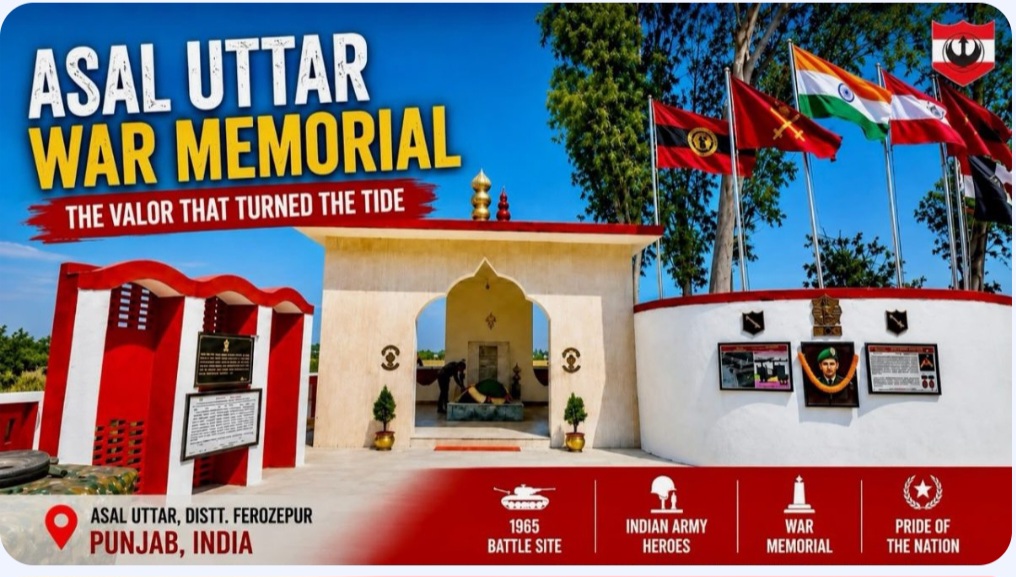
Asal Uttar in Khemkaran sector is the battlefield where extraordinary courage and determination transformed adversity into victory. It left behind a legacy that continues to inspire generations of warriors.
It was here when Indian soldiers turned the battlefield into a graveyard of Pakistani tanks during India-Pakistan war in 1965. The battle is described as one of the largest tank battles in war history.
The Company Quartermaster Havildar Abdul Hamid was the hero of this battle and was posthumously awarded with India’s highest military decoration, the Param Vir Chakra, for his actions and conspicuous bravery.
Today, the Asal Uttar War Memorial stands as a solemn reminder of sacrifice, resilience and triumph against overwhelming odds.
This first Military Heritage Memorial and Museum in Asal Uttar is a joint initiative of the Army and The Indian National Trust for Art and Cultural Heritage’s (INTACH).
INTACH Punjab Convener, Maj. Gen. Balwinder Singh (Retd.) said that this is Punjab’s first military heritage site which was dedicated to the Nation by Punjab Governor Gulab Chand Kataria and then GOC-in-C Western Command, Lt Gen Manoj Kumar Katiyar in October, last year.
Gen. Singh said that the national trust had also coordinated with the Army for opening up Ferozpur Fort for the Public on Sundays and Public Holidays.