

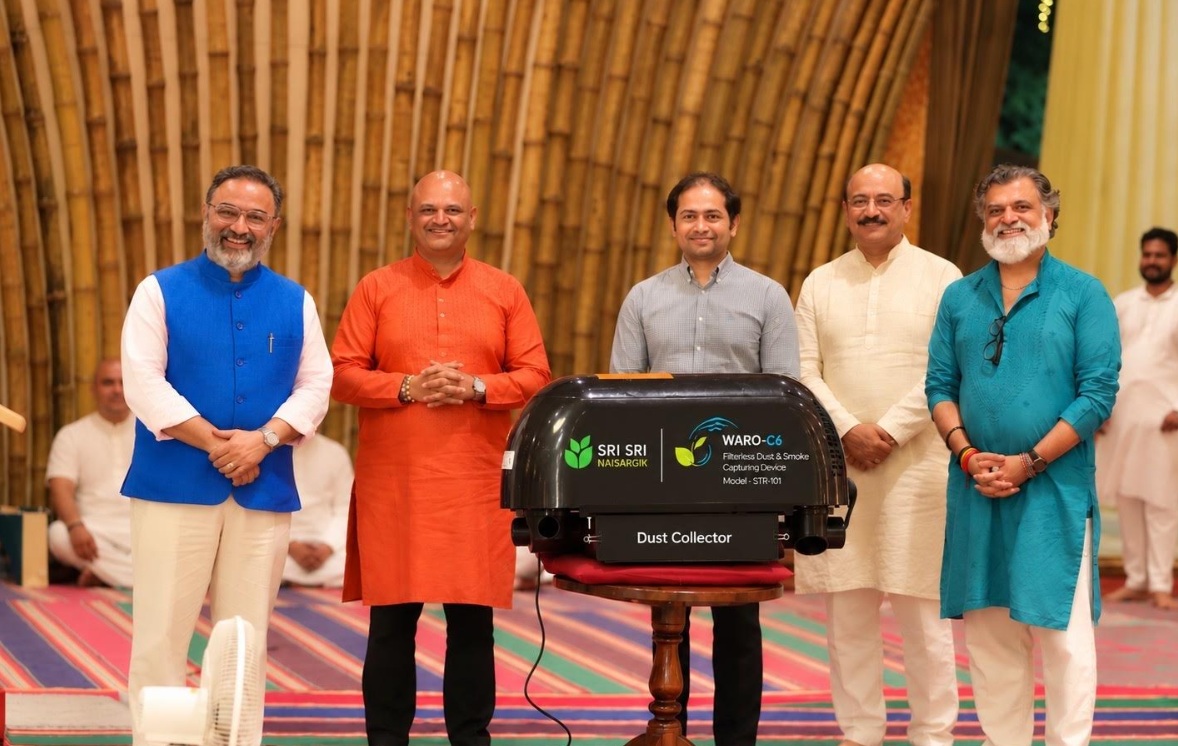
As air pollution continues to pose a growing challenge for cities and industrial centres, Zerocarbontech24, a Mumbai-based company, and The Art of Living – Sri Sri Naisargik (AOL-SSN), Bengaluru, have jointly developed and marketing WARO-C6, an outdoor, solar-powered, filterless air purification and carbon-capture device designed to capture airborne pollutants closer to their source.
WARO-C6 unveiled at The Art of Living International Centre, Bengaluru
The innovation comes at a time when conventional approaches to urban air pollution management, including road sweeping and water sprinkling, are increasingly being supplemented by technologies that seek to capture pollutants before they disperse into the surrounding environment.
WARO-C6 Brings Innovative, Sustainable Air-Pollution Control Technology to Urban Hubs
WARO-C6 is designed for deployment in high-pollution zones, including roadsides, traffic corridors, industrial premises and other locations where airborne dust and particulate emissions can affect surrounding communities.
Addressing pollution where it originates
Air pollution is a complex environmental challenge arising from multiple sources, including vehicle emissions, industrial activity, construction, road dust and the burning of fuels and waste. Fine particulate matter, particularly PM2.5, is a significant concern because its small size allows it to penetrate deep into the respiratory system.
While citywide emission controls remain essential to reducing pollution, technologies that capture airborne pollutants at or near their source may provide an additional tool for managing localised pollution hotspots.
WARO-C6 has been developed around this approach. Rather than relying on conventional filtration systems, the device uses a proprietary, software-controlled mechanism designed to draw in polluted ambient air and capture particulate matter.
According to the company, the system operates without traditional physical filters, ionisation, ultraviolet light, magnetic fields or high-voltage components. Its operating mechanism uses static principles, internal air pressure and kinetic energy, managed through a low-voltage electronic chip.
The company positions this filterless approach as a way to reduce dependence on replaceable filter consumables and minimise routine maintenance requirements.
How the technology works
WARO-C6 is designed to draw polluted air into the device, capture particulate pollutants and release treated air back into the surrounding environment.
The company states that each unit can process approximately 30 litres of air per second, equivalent to a claimed capacity of up to 300,000 litres per hour. The system is designed to capture particles across different size categories, including PM1.0, PM2.5 and PM10, along with dust and smoke.
These performance figures describe the volume of air processed, rather than the amount of pollution removed. Actual air-quality improvement in an open environment depends on factors such as pollutant concentration, wind speed, atmospheric conditions, device placement and the rate at which new pollution enters the area.
A low-energy, water-free approach
One of the stated features of WARO-C6 is its low-voltage power requirement. The device is designed to operate on 12V DC power, with solar energy, batteries or grid electricity serving as potential power sources.
The company also refers to a 14-volt solar-powered configuration.
Its dry-operation model is intended to avoid water consumption, distinguishing it from water-based dust suppression methods commonly used on roads and construction sites.
The combination of solar compatibility, low-voltage operation and filterless design could make the system relevant to locations where access to conventional power infrastructure is limited or where recurring operational costs are a concern.
Turning captured pollutants into usable materials
A central element of WARO-C6’s proposed design is its circular-economy approach.
Instead of treating captured dust and particulate matter solely as waste, the company says the system is designed to collect pollutants for potential reuse in construction materials such as paver blocks and bricks.
This approach seeks to connect air pollution management with resource recovery, potentially reducing the amount of material requiring disposal while creating opportunities for reuse.
AI and real-time environmental monitoring
WARO-C6 also incorporates artificial intelligence and Internet of Things (IoT) capabilities, according to the company.
The system is equipped with environmental sensors intended to monitor parameters such as particulate matter, rainfall and temperature. GPS tracking and a live dashboard are designed to provide information about device locations and operating conditions.
These features could help operators track equipment performance, monitor local environmental conditions and identify locations requiring additional pollution-control measures.
For municipal authorities and industrial operators, the availability of location-specific monitoring data may support more informed decisions about deployment and maintenance.
Multiple deployment possibilities
The WARO technology platform is designed for different operating environments. The company identifies pole-mounted systems, road-divider installations and higher-capacity industrial configurations among its deployment models.
These include STR-101 for pole mounting, DVR-101 for road-divider applications, and THOR-101 and IG-101 for heavy industrial environments.
Such configurations are intended to allow pollution-control equipment to be positioned closer to potential emission sources rather than relying exclusively on centralised infrastructure.
Technology as part of a wider pollution-control strategy
The development of WARO-C6 reflects growing interest in technologies that combine localised pollution capture, energy efficiency and digital monitoring.
Its filterless design, solar compatibility and proposed pollutant-recovery model distinguish it from conventional air-purification systems. Its potential application in open environments also raises a different set of questions from indoor air purification, where air movement and treatment conditions can be more controlled.
Independent evaluation of its performance under varied outdoor conditions will be important in determining how effectively the technology can contribute to ambient air-quality improvement.
Ultimately, devices such as WARO-C6 are not substitutes for reducing pollution at its source through cleaner energy, transport, industrial processes and construction practices. Their potential role lies in complementing those measures by capturing pollutants that are already airborne.
As cities and industries explore additional ways to manage pollution hotspots, technologies that combine targeted capture, low-resource operation and transparent monitoring may become part of a broader portfolio of environmental solutions.
For WARO-C6, the next phase of its journey will depend on demonstrated performance across real-world settings, the safe handling of captured pollutants and the ability to deliver measurable, sustained improvements in local air quality.
About The Art of Living – Sri Sri Naisargik
As a flagship initiative of The Art of Living, Sri Sri Naisargik is an innovation-led enterprise developing sustainable, nature-based and technology-enabled solutions for environmental protection, resource recovery, rural development and climate resilience. Its portfolio addresses land, water, air and odour pollution mitigation, along with solid waste management through practical solutions that combine innovation with measurable environmental, economic and social impact.
Follow: www.instagram.com/artofliving.ssn
Like: www.facebook.com/srisrinaisargikssn
Message: www.linkedin.com/company/sri-sri-naisargik
YouTube: www.youtube.com/@SriSriNaisargikSSN