

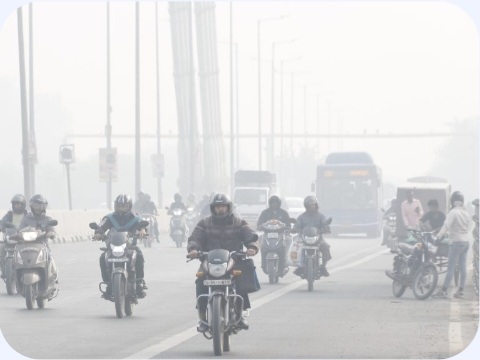
The Commission for Air Quality Management in the National Capital Region and Adjoining Areas (CAQM) Sub-Committee on the Graded Response Action Plan (GRAP) today invoked all actions under Stage-2 of GRAP with immediate effect across the entire NCR.
The decision came after Delhi’s Air Quality Index was recorded at 324 today, placing it in the ‘Very Poor’ category.
Under Stage- 2 of GRAP, concerned agencies have been directed to intensify mechanical and vacuum sweeping of roads, along with regular water sprinkling and the use of dust suppressants, particularly on heavy traffic corridors and congestion points.
The authorities have also been asked to take targeted measures to control pollution at identified hotspots and intensify inspections at construction and demolition sites to ensure compliance with dust control norms.
The action plan also includes increasing parking fees to discourage the use of private vehicles. Resident Welfare Associations have been directed to provide electric heaters to security, sanitation and other support staff to prevent open burning of biomass and waste during winter.
The Delhi Government and NCR state governments have also been advised to stagger the timings of public offices and municipal bodies in Delhi, Gurugram, Faridabad, Ghaziabad and Gautam Buddha Nagar. Other NCR states may also consider similar measures.
The Sub-Committee has directed all concerned agencies in the NCR to implement measures under Stage-2 of GRAP in addition to the Stage-1 measures already in force. The CAQM said it is closely monitoring the situation and will regularly review the air quality scenario in the coming days.
The CAQM has urged citizens to cooperate in implementing GRAP measures. People have been advised to use public transport, minimise the use of personal vehicles, avoiddust-generating construction activities and avoid open burning of waste.
Delhi Metro Rail Corporation has announced that it will operate 20 additional train trips on weekdays from tomorrow following the implementation of GRAP-2 in Delhi.
With this, the total number of additional train trips on the Delhi Metro network will increase to 40. DMRC said that this move aims to encourage more people to use public transport instead of private vehicles and help curb air pollution in the city.