

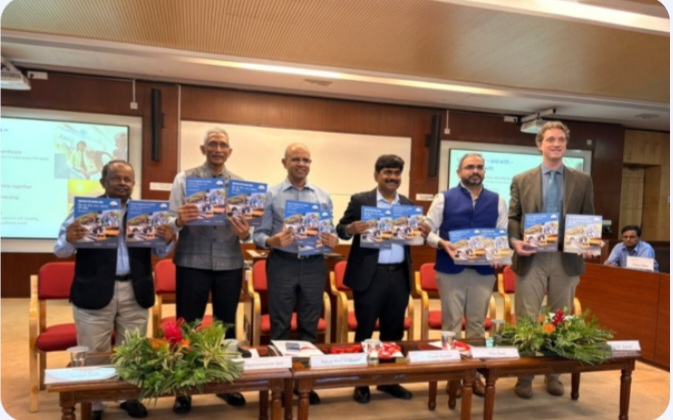
A case study on the evolution of water governance in Gujarat and India was launched at IIM Bengaluru yesterday in the presence of Secretary, Department of Drinking Water and Sanitation under the Ministry of Jal Shakti, Ashok Kumar Meena.
Co-authored by Assistant Professor at George Mason University Dr Daniel Smith, Dr Nitin Bassi, Fellow at the Council on Energy, Environment and Water, and others, the case study draws lessons for policymakers and practitioners of water governance across the Global South.
Taking a page from the case study, Jal Shakti Secretary Ashok Kumar Meena spoke about how a people’s mission, backed by strong institutions, steady investment and Gram Panchayat ownership, can accelerate transformation.
He informed that, according to the model envisioned by Prime Minister Narendra Modi, the Water and Sanitation Management Organisation conceived the Jal Jeevan Mission based on shared community participation.
Speaking about Jal Jeevan Mission 2.0, Mr Meena said the mission is now transitioning from asset creation to long-term service delivery. The village panchayats will run localised micro-utilities, sustained by grants and user-fee collections.
Addressing the media, former Secretary in the Department of Drinking Water and Sanitation, Parameswaran Iyer, spoke about key learnings from the case study, including political leadership, public participation and the role of panchayats as envisioned by Prime Minister Narendra Modi.