

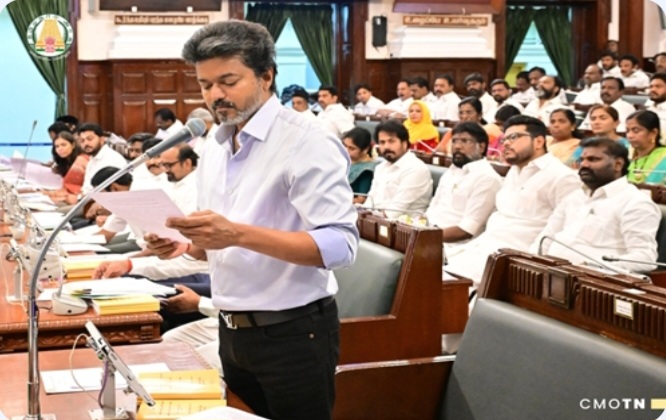
Tamil Nadu Assembly today unanimously adopted a resolution urging the Union Government to take immediate and necessary action to facilitate the use of Tamil as the principal language of the Madras High Court.
Moving the resolution at the State Assembly, Chief Minister C. Joseph Vijay pointed out that under Section 2 of the Tamil Nādu Official Language Act 1956, Tamil has been declared as the official language.
Under Sections 4-A and 4-B of the Act, legal recognition has been provided for recording evidence in Tamil in the civil and criminal courts, tribunals, tent courts and revenue Courts functioning under the High Court.
The Chief Minister also noted that under Article 348(2) of the Constitution of India, a constitutional mechanism is provided whereby the Governor of a State, with the previous consent of the President of India, may authorise the use of the official language of the State in the proceedings of the High Court.
The resolution passed in the Assembly underlines the need to reconsider the necessity of making Tamil the principal language and establish appropriate procedures for petitions, documents and arguments filed or presented in Tamil, as significant advancements have been made in legal Tamil, translation, e -courts, technology-enabled translation and legal databases.
The Statement also mentioned that Artificial intelligence technologies have advanced to the extent that speech in Tamil can be simultaneously rendered and heard in English.
The resolution also suggested training in legal Tamil and translation for Judges, advocates and Court Personnel and take all necessary legal measures on proposals to be forwarded by the Governor of the State under Article 348 (2) of the Indian Constitution and Section 7 of the Official Languages Act, 1963.
Speaking on the resolution, members from various parties supported the Government and said that this is a definitive move so that a common man can understand his case related arguments happening to him or her.