

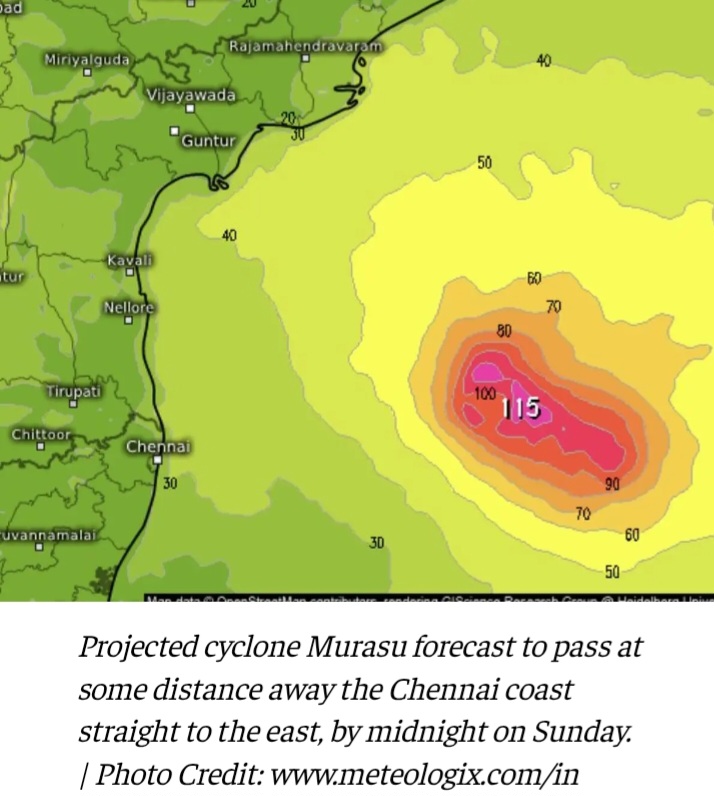
A fresh weather system over the southeast Bay of Bengal has intensified into a depression and is forecast to become Cyclone Murasu, threatening the Andhra Pradesh coast and India’s eastern coast.
The India Meteorological Department (IMD) expects the system to develop into a cyclonic storm and approach or cross the south Andhra Pradesh coast between Monday evening (November 2) and Tuesday morning (November 3). The storm follows closely behind Cyclone Arnab, which severely devastated parts of the eastern coast just days ago.
Expected Track, Landfall, and Wind Speeds. According to the IMD updates on Times of India, the system is moving west-northwestwards.
While the exact landfall coordinates are still being monitored, meteorologists indicate the system will likely make landfall along the South Andhra Pradesh coast, with projected areas ranging from Kakinada down towards the Ongole and Nellore region.
Once it fully develops into a cyclonic storm, it will carry the name Murasu (meaning “drum” in Tamil, a name proposed by India).
The storm is expected to bring sustained wind speeds of 80 to 90 kmph, gusting up to 100 kmph, as it hits the coastal belt.
Heavy Rainfall and Regional Alerts. Extremely heavy downpours and strong winds are projected across several states on India’s eastern coast as the system moves closer:
Andhra Pradesh & Yanam. Heavy to very heavy rainfall is predicted on November 2 and 3. Thunderstorms and lightning accompanied by 30-50 kmph winds are expected to start impacting coastal areas immediately.
Odisha. Southern districts—including Rayagada, Koraput, Malkangiri, Ganjam, and Gajapati—which are already dealing with the aftermath and landslides from Cyclone Arnab, are under a heavy rainfall alert for November 1 to 4.
Tamil Nadu, Puducherry & Kerala. The IMD has extended heavy rain alerts for these southern regions, with precipitation expected to persist through November 4 and 5 due to the broader weather system.
Safety Warnings and Preparedness. The IMD has officially issued a strict advisory warning fishermen not to venture into the west-central, southeast, and central parts of the Bay of Bengal until at least Wednesday afternoon.
Small boats and ships already out at sea have been urgently advised to return to harbours due to increasingly hazardous sea conditions.
Meanwhile, state disaster management teams in both Andhra Pradesh and Odisha remain on high alert as they balance ongoing Arnab recovery efforts with preparations for this second imminent storm.