

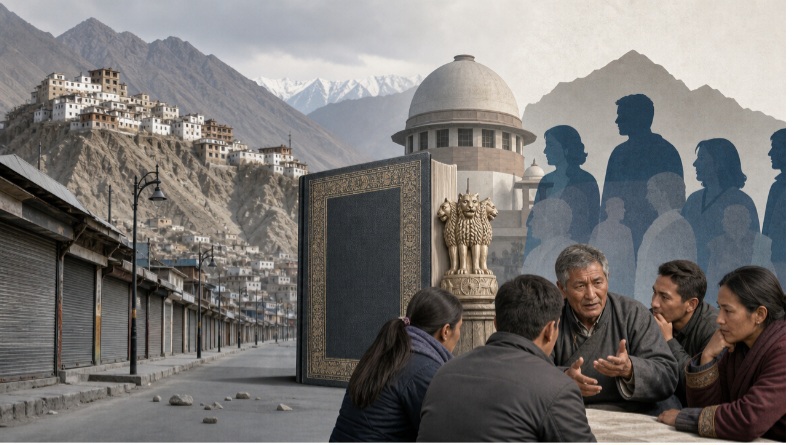
Shutdown amid excise policy, land & power concerns.
Normal life was affected in the principal towns of Leh and Kargil as markets, shops, business establishments and private institutions remained closed in response to the bandh call.
A large public protest was also held in Leh, where leaders and residents raised concerns over a series of decisions taken by the Union Territory administration, including the recently introduced excise policy, the ongoing digitisation of land records, alleged moves toward privatisation of the Power Department, and policy decisions linked to land, transport and tourism
SRINAGAR: A daylong shutdown was observed across several parts of Ladakh on Tuesday after the Leh Apex Body (LAB) and the Kargil Democratic Alliance (KDA) called for a region-wide bandh to protest what they described as the Centre’s delay in addressing Ladakh’s political, constitutional and administrative demands.
Normal life was affected in the principal towns of Leh and Kargil as markets, shops, business establishments and private institutions remained closed in response to the bandh call.
A large public protest was also held in Leh, where leaders and residents raised concerns over a series of decisions taken by the Union Territory administration, including the recently introduced excise policy, the ongoing digitisation of land records, alleged moves toward privatisation of the Power Department, and policy decisions linked to land, transport and tourism.
The organisers said the protest was not merely against individual administrative decisions but against a broader pattern of governance in which, they alleged, decisions affecting Ladakh’s future were being taken without adequate consultation with local stakeholders, elected representatives and civil society platforms.
The shutdown came amid dissatisfaction within LAB and KDA over the official minutes of the May 22 meeting held under the Ministry of Home Affairs in New Delhi.
Ladakhi leaders have claimed that important understandings reached during that meeting—particularly on a proposed democratic structure for Ladakh with legislative, executive and financial powers—were either omitted or inadequately reflected in the official record.
LAB and KDA have been jointly spearheading a campaign seeking statehood for Ladakh, constitutional safeguards under the Sixth Schedule, protection of land and employment rights, and greater participation of local people in governance.
The groups maintain that the absence of an elected legislature and strong constitutional guarantees has deepened anxieties over land, jobs, culture, environment and administrative accountability in the strategically important Himalayan region.
Leh Apex Body co-chairman Chering Dorjay Lakruk, while speaking ahead of the bandh, accused the government of adopting delaying tactics and urged that the official minutes be corrected to reflect the decisions reached during talks.
“We expect the government to rectify the minutes and ensure that all decisions taken during the meeting are accurately reflected. It cannot be a case of taking two steps forward and two steps backward. Such an approach only raises doubts about the government’s intentions,” he said.
Lakruk also warned that the leadership would not remain silent if the concerns of the people continued to be ignored. “We have many ways to protest.
The government should not think it has two months to continue delaying decisions while selling Ladakh’s interests. We are aware what is happening behind the scenes,” he said, adding that the entire region would observe the shutdown while transport services were exempted in view of the ongoing tourist season.
In Leh, the bandh was marked by a major gathering at the Polo Ground, where religious, political and civil society representatives addressed the public.
Speakers said the protest was intended to convey that Ladakh’s political future, land protections, administrative powers and economic resources cannot be decided without the consent of its people. They also called for credible and sincere dialogue with the Centre to resolve pending issues peacefully.
Kargil too witnessed a near-complete shutdown, with markets, business establishments and institutions remaining closed. Local residents and leaders said the protest reflected shared concerns across Ladakh over the handling of land records, power sector restructuring, administrative decisions and the delay in granting constitutional protections.
The LAB-KDA leadership warned that if meaningful progress is not made on agreed points, the scope of public protests may be expanded in the coming days.
The shutdown remained largely peaceful, with transport services continuing in many areas to minimise inconvenience to residents and tourists.
However, the scale of participation underlined the widening trust deficit between Ladakh’s representative platforms and the authorities, and signalled that the demand for constitutional safeguards, democratic representation and local control over land and resources remains at the centre of the region’s political mobilisation.